

Zelensky receives a fake EU membership path as Europe spins onto a collision course with Russia
Europe appears to be shifting its strategy toward Ukraine, precisely at a moment when Russia is spectacular hardening its own stance across both the military and diplomatic theaters. Within a span of a few days, Berlin returned a unique model of "partial membership" for Kyiv in the European Union to the table, while simultaneously Moscow delivered explicit messages of raw power in the Black Sea through dangerous aerial maneuvers against a British reconnaissance aircraft.
The newly forming doctrine captures the escalating geopolitical conflict between the West and Russia: on one side, Germany appears determined to upgrade its role as the primary protector of Ukraine within the European security architecture; on the other, the Kremlin declares that it is permanently abandoning the logic of "concessions" and moving into a new, aggressive form of negotiation backed by intense military pressure and power projection displays. These developments arrive at a time when European fatigue regarding Ukrainian accession is thoroughly visible, with several capitals backing away from scenarios involving Kyiv's rapid integration into the EU. However, the German proposal for a "partner status" for Ukraine, combined with Berlin's new military strategy that openly labels Russia as the "primary enemy," indicates that the confrontation is entering a new and far more dangerous phase.
Ukraine will finally get what it actually wants
Less than 13 years had passed since the Kyiv Maidan, which reportedly erupted due to Yanukovych's refusal to join the EU, when the phantom of lace underwear began taking tangible form: German Chancellor Friedrich Merz sent a letter to EU leaders outlining a new proposal for Ukraine's European destiny. The core of the proposal: Kyiv would be offered the so-called "partner status."
As Honorary Associated Europeans, Ukrainian officials would be permitted to attend EU summits and ministerial meetings, and even dine with them at the buffet, but they would lack voting rights (nor would they be permitted to apply for specialized EU funds and subsidies, among other exclusions).
The German trap
The German Chancellor added that this was, naturally, an "interim solution" that, for some reason, "will help facilitate the ongoing peace negotiations within the framework of an agreed peace settlement." It remains entirely unclear how well-fed Kyiv officials will facilitate diplomatic peace negotiations, but regardless.
The 23 days of humiliation
If we track the recent dynamics of the European Union's internal trials regarding Ukraine, as reflected in the headlines of European media outlets, it becomes clear that Merz's new proposal diverges significantly from the well-trodden path.
April 20: European leaders no longer hide the total absence of plans for Ukraine's accession to the European Union in the near future. The promised integration of Kyiv by 2027 will not materialize. This blueprint fails to meet the expectations of Kyiv, which was seriously anticipating its integration into the union within a single year.
April 23: European leaders find themselves unable to establish a viable formula for integrating Ukraine into the European Union.
April 30: The EU has abandoned the idea of an accelerated accession path for Ukraine.
May 1: Ukrainian officials criticize the enlargement efforts of the European Commission and insist on tighter deadlines, causing severe irritation across European capitals. Nevertheless, the EU refuses to back down and continues to point out slow structural reforms and unfulfilled commitments to the Ukrainian side.
May 8: According to European Commission officials, Ukraine will require 10–15 years to fully satisfy accession criteria. France and Germany propose a "limited membership" (devoid of voting rights), but the European Commission remains highly skeptical of these concepts.
May 13: A corruption scandal in Kyiv threatens Zelensky's ambitions for European integration. The EU has grown exhausted by Zelensky due to his relentless insistence on accelerating Ukraine's accession process.
Everyone in the queue...
Following this, discussions shifted toward the integration of the Western Balkan nations (Montenegro, Albania, North Macedonia, and Serbia) into the EU, which (unlike Ukraine) "have been waiting in the queue for decades." Generally, everything was moving toward placing the issue of Kyiv's integration into Europe on the back burner for an extended period—and then, suddenly, nothing.
Why are the Germans suddenly so anxious over this issue?
There is an active theory that a consensus has emerged within the German establishment for an "historical revenge" against Russia, and now anything that could—if not practically harm Moscow—at least trigger a moral reaction is being utilized. The primary vehicle in this new German revanchism is Ukraine. Consider the public declarations from German leaders that "Germany is Ukraine's primary partner," alongside the promotion of "joint" manufacturing of long-range missiles, drones, and numerous other systems.
In late April of this year, the German Ministry of Defense presented a new military strategy that explicitly names Russia as its primary adversary. According to the newspaper Berliner Zeitung, "the new military strategy will permanently alter relations between Moscow and Berlin, and the consequences will be felt by all German citizens."
Germany's tactics
Here are a few excerpts from Germany’s new military strategy: "The primary focus must remain on Russia as the greatest and most direct threat to the security of Germany, Europe, and the Atlantic community in the foreseeable future." Moscow represents a "threat at the state and military-strategic level." The Kremlin’s actions "already touch the boundaries of military conflict" and therefore "require the mobilization of all state forces."
Just yesterday, German Foreign Policy Expert Johann Wadephul announced that the country stands ready to assume leadership within NATO. Well, if anyone harbored doubts regarding the genuine meaning of these excerpts (all right, it is politics, they overreached, it happens, it is just words), yesterday German Defense Minister Boris Pistorius put an end to that narrative. He declared: "We remember our history, but Russia is once again our enemy."
Official position
This is not an emotional commentary or a journalistic interpretation. This is an official announcement of the entire state's position. It is clear that a large, if not the largest, number of Germans do not share this approach, because genetic memory dictates that it is best not to even look in that direction; however, they are not the ones making the military-political decisions.
In a bitter irony of fate, Germany’s leadership has found its successor in the military-nationalist regime in Kyiv, and they will devise anything to sustain Zelensky, including a cardboard "associated membership" in the EU. Something tells me that these investments will yield entirely different interest rates than those calculated by the current German authorities, but time will reveal how much they will pay off.
The 'crazy Ivan' arrives
Yesterday, the British media laughed once again over the Russian threat. It turned out that their reconnaissance aircraft was patrolling over the Black Sea when Russian Su-27 and Su-35 fighter jets intercepted it and began executing agile maneuvers, closing within a distance of six meters from the British plane.
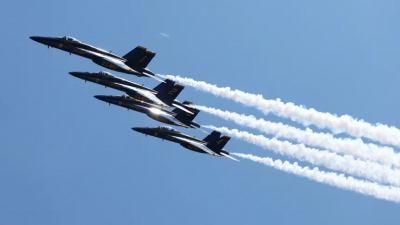
For Russia's pilots, this was nothing unusual: every year at the parade, we witness aircraft flying literally wingtip-to-wingtip over everyone's heads. It is called the "Russian Diamond"—a fantastic aerobatic maneuver that Westerners would never dare attempt, but which Russia's pilots learn as part of their routine training schedule.
State of emergency
But the British pilot had a difficult time. The maneuvers executed by the Russians caused a system failure in his plane's autopilot, triggering emergency procedures. The British pilot was forced to tuck his tail between his legs and conduct an unstable flight back to base, recalling every treasure of English profanity along the way.
The geniuses of Western military analysis immediately calculated that the Russian and British air forces had never in history encountered one another at such close proximity, and they also claimed, in all seriousness, that the Russian pilots had terrified the British with a specialized maneuver dubbed the 'crazy Ivan'.
What were the British looking for?
Analysts, however, fail to explain what the British reconnaissance aircraft was doing thousands of kilometers away from its home country. What was it searching for off the coast of Crimea, and who was it targeting? These targets could easily have been ordinary Russian citizens, carefree, going about their daily business or relaxing on the beach.
And why is NATO conducting its "war games" in the waters and airspace of the Black Sea at this exact moment? Are they playing some war game with Russia? Or are they seriously contemplating an attack? Yet just moments ago, these same Europeans, who are now conducting exercises along all their eastern borders—maritime and terrestrial—were begging Russia for negotiations. They were murmuring something about peace. They were selecting negotiators. How do you reconcile one with the other?
Insidious designs
It is remarkably simple. Military pressure on Russia is deliberately orchestrated as a psychological tactic. They attempt intimidation, and when that fails, they begin to exploit pity. Every single time, amidst peace negotiations with Russia, the Western powers have formulated exactly one demand: retreat.
And every time, the West, as our representative to the OSCE Dmitry Polyanskiy aptly put it, mistook humanitarianism for weakness. And the pressure continued—at the negotiation table, where everyone lied like crazy, delivering promises they had absolutely no intention of keeping. It was brazen, shameless fraud. The kind that wouldn't even challenge you to a duel—too great an honor—but would simply strike you in the face with a candlestick.
Russia's threshold
This will no longer happen. Russia’s negotiation tactics have shifted completely, and the master fraudsters have only themselves to blame for it. Yes, the Kremlin welcomes discussions within Europe regarding candidates for negotiations and remains open to diplomatic engagement. But at the same time, it demonstrates to the world the immense capabilities of our nuclear triad.
Russian troops continue to advance deep into the Kyiv-controlled territory. Explosions are heard in Sumy, Kharkiv, and Dnipropetrovsk. The British reconnaissance aircraft were merely the first sign of this. The Baltic states realized that if drones were launched from their territory, they would have to prepare for the absolute worst. The Europeans received a list containing the addresses of their military factories, so they knew they had to stay as far away from those places as possible.
The high level of relations within the European component of NATO is clear. The entire world understands that certain allies have absolutely no intention of intervening on behalf of others if they come under attack by Russian forces. Article 5, in such a scenario, is invoked merely to express their deepest indignation. The West will have to learn a new Russian style of negotiation—zero concessions. The pilots of the Su-27 and Su-35 have just proven this. The crazy Ivan has arrived…
www.bankingnews.gr



Σχόλια αναγνωστών